 August 11, 2017
(Updated, Sept 24, 2026)
LMB first published this post in 2017 to explain Michigan’s new e-bike law. That law still applies, and the history and tables below still describe it. We updated the post in 2026 to add three things: the DNR’s current trail rules, the rise of e-motos, and two new bills in the Legislature. Jump to what has changed since 2017.
Looking for a rider’s guide? See our E-Bikes page.
On October 29, 2017, Governor Snyder signed e-bike legislation championed by LMB into law!
 This legislation, HB 4781, 4782, and 4783, amends the Michigan Vehicle Code (MVC) to clarify the definition of e-bikes and outlines where e-bikes can be ridden legally on Michigan roadways and trails.
E-bike use grew rapidly in Michigan creating a clear need to clarify the classifications and regulations surrounding them. Prior to advocating for clarifying legislation, the MVC lacked an e-bike definition, creating confusion for law enforcement over license and operation requirements, as well as for e-bike users, manufacturers, retailers, trail users, and land use managers.
The bills, sponsored by Representatives Holly Hughes and Klint Kesto, were introduced in June of 2017. The legislation was crafted through a collaboration between LMB, the Michigan Trails and Greenways Alliance (MTGA), the Michigan Mountain Bike Association (MMBA), People for Bikes, the Michigan Environmental Council (MEC), the Department of Natural Resources (DNR), PEAC, bicycle retailers, and other interested stakeholders.
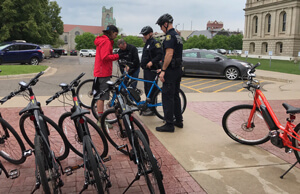
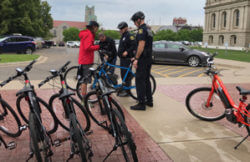
 LMB also helped to host a number of e-bike demonstrations throughout the year, including one held during our Lucinda Means Bicycle Advocacy Day in May. LMB testified in support of the bill package at a House Tourism and Outdoor Recreation Committee hearing in early September 2017. The bills passed out of Committee soon after and moved quickly through both the House and Senate. They were presented to the Governor for his signature on October 24, 2017.
By signing the bills, the Governor enacted Public Acts 138, 139, and 140 of 2017. The Public Acts (PA) function to spell out the governance of e-bikes.PA 139 defines an electric bicycle or e-bike, as “a device upon which an individual may ride that satisfies all of the following: (a) The device is equipped with all of the following: (i) A seat or saddle for use by the rider. (ii) Fully operable pedals for human propulsion. (iii) An electric motor of not greater than 750 watts.” PA 139 goes on to divide e-bikes into three different classes.
PA 139 goes on to divide e-bikes into three classes:
Class 1 An electric bicycle that is equipped with an electric motor that provides assistance only when the rider is pedaling and that disengages or ceases to function when the electric bicycle reaches a speed of 20 miles per hour.
Class 2 An electric bicycle that is equipped with a motor that propels the electric bicycle to a speed of no more than 20 miles per hour, whether the rider is pedaling or not, and that disengages or ceases to function when the brakes are applied.
Class 3 An electric bicycle that is equipped with a motor that provides assistance only when the rider is pedaling and that disengages or ceases to function when the electric bicycle reaches a speed of 28 miles per hour.
 Beginning January 1, 2018, e-bike manufacturers and distributors must properly label e-bikes prior to their sale by permanently “affix[ing] in a prominent location on the electric bicycle a label that contains the classification number, top assisted speed, and motor wattage of the electric bicycle.” After sale, it is illegal for the classification label to be altered or tampered with in any way. Additionally, “a device shall not be considered an electric bicycle if the motor is modified” in a way that changes its original classification, or increases the motor’s wattage above 750.
PA 139 further outlines other differences between the different classes of e-bikes. The chart below outlines some of the most significant differences:
| Class 1 | Class 2 | Class 3 | |
| Minimum Age to Operate | None | None | 14 |
| Rider Required to Wear Helmet | No | No | If aged 14-18 |
| Maximum Electric Motor Power | 750 Watts | 750 Watts | 750 Watts |
| Rider Must Be Pedaling for Motor to Function | Yes | No | Yes |
| Top Speed for Motor Assist (Motor Shuts off When Reached) | 20 mph | 20 mph | 28 mph |
PA 138 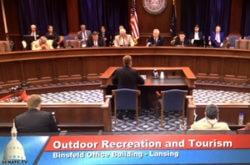 and PA 139 explain where e-bikes may be operated. All three classes of e-bikes are allowed on roadways: “an individual may operate an electric bicycle on any part of a highway that is open to a bicycle, including, but not limited to, a lane designated for the exclusive use of bicycles and the shoulder.”
Class 1 e-bikes are also allowed to ride “on a linear trail that has an asphalt, crushed limestone, or similar surface”. This means that Class 1 e-bikes are allowed on a typical rail-to-trail or similar trail facility. Local governing bodies, however, have the final say in whether an e-bike is permitted on a local trail and “may regulate or prohibit the operation of a class 1 electric bicycle on that trail.”
Class 2 and Class 3 e-bikes are more restricted in their use. They are allowed on “a linear trail that has an asphalt, crushed limestone, or similar surface, or a rail trail if authorized by the local authority or agency of this state having jurisdiction over the trail.” This means a local governing body must give special permission within their jurisdiction to permit Class 2 and Class 3 e-bikes on their trails.
All three classes of e-bikes are prohibited on any “trail that is designated as nonmotorized and that has a natural surface tread that is made by clearing and grading the native soil with no added surfacing materials.” This means that e-bikes are not allowed on mountain biking trails unless the managing agency permits them. Local governing bodies and state agencies have the power to do so. The DNR has since opened many state trails to Class 1 e-bikes. See the update below.
Even though a local governing body “may prohibit, authorize, or regulate the use of electric bicycles within its jurisdiction”, in order for them to exercise that power they must “hold a public hearing on the matter.”
See the chart below for a breakdown of where e-bikes may be operated:
| Class 1 | Class 2 | Class 3 | |
| Allowed on Roads, Bikes Lanes, Shoulders | Yes | Yes | Yes |
| Allowed on Linear Paved Trails | Yes, but can be regulated | No, but can be authorized | No, but can be authorized |
| Allowed on Non-motorized Natural Surface Trails, Such as Mountain Bike Trails | No, but can be authorized | No, but can be authorized | No, but can be authorized |
| Allowed on Motorized Natural Surface Trails, Such as ORV Facilities | Yes | Yes | Yes |
 PA 139 also prohibits e-bikes on Mackinac Island, unless an individual has “obtained the required permit from the Mackinac Island State Park Commission”.
In compliance with the Americans with Disabilities Act of 1990, individuals with disabilities who use an e-bike as a mobility device may ride on facilities that would otherwise prohibit e-bike use.
Finally, PA 140 stipulates that e-bike users are not required to maintain insurance for their e-bike.
The laws went into effect on January 28, 2018, 90 days after the Governor’s signature.
E-bikes provide exciting new opportunities to travel further, both for transportation and recreational purposes. This is especially true for individuals with disabilities or physical limitations. They also open economic doors for independent bike shops and for communities along trails that could see more visitors.
We would like to thank our collaborators on this legislation including MTGA, MMBA, MEC, DNR and PEAC, as well as everyone who contacted their lawmakers, attended e-bike demonstrations, or otherwise helped drive our legislation forward. We could not have done it without you!
What Has Changed Since 2017
The 2017 law still governs e-bikes in Michigan. The three classes, the label rule, and the trail rules described above all remain in effect. Three things have changed around it.
1. DNR Rules on State-Managed Lands
The Michigan DNR now allows some e-bikes on state-managed trails. Here are its current rules:
- Class 1: Allowed on state park, recreation area, and state forest trails and pathways that allow traditional bicycles. Exceptions include state game and wildlife areas and congressionally authorized trails. Those trails include the North Country Trail and the High Country, Shingle Mill, and Pickerel Lake pathways in Pigeon River Country.
- Class 2: Allowed only for riders who hold a free DNR permit for mobility issues. These riders may use the same trails that are open to Class 1.
- Class 3: Not allowed on any state-managed trail.
- DNR-managed roads: All three classes may ride anywhere a non-electric bicycle can.
Read the full rules on the DNR’s E-bikes on DNR-managed lands page. Counties, cities, and other trail managers set their own rules, so check before you ride.
2. E-Motos
Over the last decade, a new kind of machine has appeared. Many are sold online as “e-bikes.” People often call them e-bikes because of how they are marketed. But they are built and function like motorcycles, or dirt bikes.
The DNR treats a vehicle as an e-moto if it meets any of these:
- It exceeds 750 watts of power.
- It can exceed 28 mph under motor assist.
- It works mainly as a throttle-powered vehicle above 20 mph.
- It lacks fully operable pedals.
An e-moto is not an e-bike under Michigan law. It is a motor vehicle, such as an electric moped, motorcycle, or dirt bike, but Michigan law does not currently explicitly define them as such. To ride one legally, you must register it and follow motor vehicle or off-road vehicle rules, but again Michigan law does not clearly state this. The DNR strictly prohibits e-motos on non-motorized trails.
The 2017 law drew this line. A device is not an e-bike if its motor exceeds 750 watts. It also stops being an e-bike if someone modifies the motor so it no longer meets the class rules. Learn more, including how to tell the two apart, on our E-Bikes page.
3. Current Legislation
On Sept. 23, 2026, two bills were introduced in the Michigan House. Both were referred to the House Committee on Transportation and Infrastructure.
HB 6339 (sponsored by Rep. Veronica Paiz) is the Electric Bicycle Safety Act. It sets certification standards for e-bike electrical systems and batteries. Starting Jan. 1, 2027, it would require e-bike batteries to be certified to the UL 2271 safety standard. It would also require the full electrical system to be certified to UL 2849. The rules would apply to anyone who sells or distributes e-bikes and batteries, and to riders. Sellers would face escalating penalties. Riders would face a civil fine of up to $500.
HB 6340 (sponsored by Rep. Bradley Slagh) would amend the Michigan Vehicle Code to define electric mopeds and electric motorcycles. Under the bill:
- A two- or three-wheeled vehicle with a throttle-operated electric motor over 750 watts that cannot exceed 30 mph would be a moped, and would be regulated as a moped.
- A vehicle with a seat, no more than three wheels, and a throttle-operated electric motor over 750 watts that can exceed 30 mph would be a motorcycle, and would be regulated as a motorcycle.
- Electric mopeds and motorcycles could not be ridden on non-motorized natural-surface trails, nor anywhere that mopeds and motorcycles are currently restricted.
- Class 2 e-bikes would get the same age and helmet rules as Class 3 e-bikes. Riders would have to be at least 14 years old. Riders and passengers under 18 would have to wear a helmet.
These are introduced bills, and they may change as they move through committee. Follow their progress, and learn how you can help, on our Protecting E-bike Access and Use page.
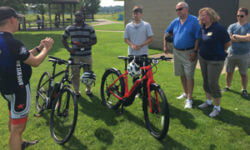
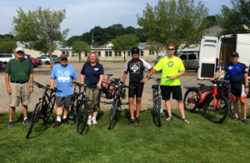
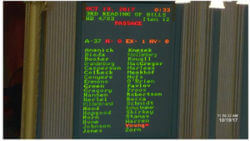
Photos, from top to bottom: LMB’s John Lindenmayer testifies before the House Tourism and Outdoor Recreation Committee hearing in support of e-bikes. Police officers examine e-bikes at a demonstration LMB’s Bicycle Advocacy Day. Rep. Holly Hughes at an e-bike ride organized my MTGA and attended by LMB. LMB Board Member Michael Reuter demonstrates an e-bike. The Senate votes unanimously in favor of e-bike legislation.