E-Bikes in Michigan: What to Know, Where to Ride, and How to Ride Smart
Electric bicycles, or e-bikes, are changing how people ride in Michigan. They make riding easier for more people. They get riders to work, to school, and out on the trail. And they support local businesses along the way.
This page covers the basics. You’ll learn what counts as a legal e-bike, where you can ride one, and how to ride safely. You’ll also learn how to spot an “e-moto” — a higher-powered machine that is sometimes sold as an e-bike but isn’t one.
What Is a Legal E-Bike?
Under Michigan law (MCL 257.13e), an e-bike has:
- A seat or saddle
- Fully operable pedals
- An electric motor of 750 watts or less
An e-bike that meets these standards is treated like a bicycle. You don’t need a license, registration, or insurance to ride one.
Michigan’s Three E-Bike Classes
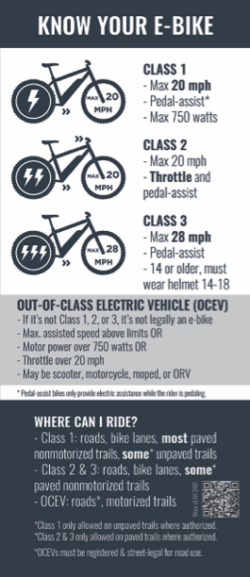
Michigan’s 2017 e-bike law sorts e-bikes into three classes. The class sets the top assisted speed and whether the bike can use a throttle.
- Class 1: The motor helps only while you pedal, up to 20 mph.
- Class 2: The motor can also run on a throttle, up to 20 mph.
- Class 3: The motor helps only while you pedal, up to 28 mph.
All three classes are bicycles under state law. But where you can ride depends on the class.
Class 3 comes with two extra rules:
- Riders must be at least 14 years old. Younger kids may ride as passengers on a Class 3 e-bike built to carry them.
- Riders and passengers under 18 must wear a bicycle helmet.
Labels and Modifications
Manufacturers must put a permanent label on every e-bike sold in Michigan. The label lists the class, the top assisted speed, and the motor wattage.
Modifying an e-bike can change its legal status. If a modified motor no longer meets the e-bike definition, or tops 750 watts, the device is no longer an e-bike under Michigan law.
E-Bike or E-Moto? Know the Difference
Not every electric two-wheeler is an e-bike. A growing number of high-powered, motorcycle-like machines are sold as “e-bikes.” These are often called e-motos or out-of-class electric vehicles (OCEVs). The labels confuse buyers. And the machines create safety risks for everyone on roads and trails.

A device is not a legal e-bike if it:
- Has a motor over 750 watts
- Exceeds its class speed limit under motor power — 20 mph on throttle, 28 mph with pedal assist
- Has no pedals, or pedals that don’t work
- Has an “off-road” mode that unlocks more speed or power
- Has been modified or “hacked” to exceed its class
Why It Matters
A device outside the e-bike definition loses e-bike rights. That means:
- It may not be allowed on bike paths or trails.
- It may need registration, a license, insurance, and street-legal equipment, like a moped or motorcycle.
- It puts trail access at risk for every e-bike rider and cyclist.
Before You Buy
- Look for the class label. No label is a red flag.
- Ask the seller about motor wattage and top speed.
- Buy from a local bike shop when you can. You’ll have better access to service and parts.
- Know that many shops won’t service OCEVs. Some also won’t work on e-bike brands they don’t sell.
See the difference at a glance:
Where Can You Ride an E-Bike?
Roads and Bike Lanes
You can ride any class of e-bike anywhere a regular bicycle can go on the road. That includes bike lanes and shoulders. Sidewalk rules vary by community, so check local ordinances.
Paved Trails and Rail-Trails
This covers trails with asphalt, crushed limestone, or similar surfaces, plus rail-trails.
- Class 1: Allowed, unless the trail manager prohibits it.
- Class 2 and 3: Allowed only where the trail manager authorizes it.
One trail may allow Class 2. The next may not. Check the rules before you ride.
Natural Surface Trails (Mountain Bike Trails)
E-bikes are not allowed on non-motorized dirt trails unless the land manager opens them. Rules vary by manager:
- Michigan DNR lands: Class 1 e-bikes are allowed on state park, recreation area, and state forest trails that allow traditional bicycles. Class 2 e-bikes are allowed only with a free DNR permit for mobility issues. Class 3 e-bikes are not allowed on any state-managed trail. Some areas are excluded, including state game and wildlife areas. See the DNR’s E-bikes on DNR-managed lands page for current rules.
- County parks and city trails: Rules vary by community.
- Other public lands: Access depends on the managing agency.
When in Doubt, Ask
Rules change from one trail or town to the next. Look for posted signs. If you’re unsure, check with the park, trail manager, or municipality before you ride.
Ride Safe, Ride Smart
Rules of the Road
E-bike riders follow the same traffic laws as other cyclists:
- Obey traffic signals and signs.
- Ride with traffic, and ride predictably.
- Signal your turns.
- Yield to pedestrians.
Class 3 riders and passengers under 18 must wear a helmet. For everyone else, helmets are strongly recommended. Some communities require them, so check local ordinances.
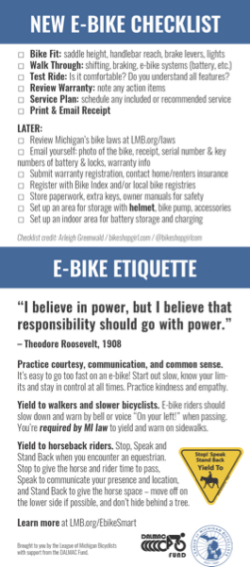
E-bike Trail and Path Etiquette
Courtesy and common sense go a long way. On shared paths:
- Keep to posted speed limits. It’s easy to go too fast on an e-bike. Start slow and stay in control.
- Yield to pedestrians and other cyclists.
- Slow down and warn when you pass. Use a bell or your voice: “On your left!” On sidewalks, Michigan law requires you to yield to pedestrians and signal before you pass.
- Yield to horses. Follow “Stop, Speak, Stand Back.” Stop to let the horse and rider pass. Speak so they know where you are. Stand back and give the horse space. Move to the downhill side if you can, and don’t hide behind a tree.
Handling Tips
- Practice braking. Stopping takes longer at higher speeds.
- Practice throttle and assist control before you ride in traffic or crowds.
- Remember that e-bikes are heavier. Allow extra stopping distance.
- Know your battery’s range so you don’t get stranded.
E-bike Care and Maintenance
Battery Care
- Store batteries in a dry, temperature-controlled space.
- Don’t charge a cold battery. Let it warm to room temperature first.
- Keep batteries away from anything that can burn, while charging and in storage.
Travel and Racks
- Use a rack rated for your e-bike’s weight.
- Remove the battery for travel when you can.
Routine Checks
- Tire pressure and brakes
- Chain and drivetrain wear
- Motor function and cables
- Battery condition
Protecting Michigan’s Three-Class System
Michigan’s three-class system works. It keeps e-bikes in the bicycle category. It gives riders, shops, and land managers clear rules. LMB works to keep it that way.
E-motos sold as e-bikes threaten that clarity. Misleading labels and marketing confuse buyers. They also feed confusion and misinformation about what e-bikes are and where they belong. LMB supports legislation that clearly defines these higher-powered machines, so e-bikes can keep their place on Michigan roads and trails.
Follow the e-moto legislation and learn how to help →
Resources
From LMB
- Download LMB’s E-Bike vs. E-Moto Infographic
- View LMB’s Protecting E-Bike Access White Paper
- Learn more about Michigan bike law
More to Explore
- PeopleForBikes: E-Bike Toolkit and Legislative Webinar
- Learn About the World of Electric Bikes
- MTGA: E-Bike Toolkit
- Is Your Child Ready for an E-Bike?